 Olympusdao
 treasury
The Olympus protocol’s treasury holds reserves and OHM liquidity positions used to back OHM, support trading and fund authorized policies on Ethereum. User principal in unconverted Convertible Deposits is held separately from treasury-owned capital.
What the treasury owns
- Reserve assets
- Reserves supply capital for backing, lending and market operations. Each policy has its own asset requirements and governance-controlled parameters.
- Protocol-owned liquidity
- Olympus controls positions providing OHM trading liquidity. Its Protocol Owned Liquidity documentation identifies an OHM/wETH Uniswap v3 position intended to provide lasting liquidity, subject to governance changes.
Holding liquidity positions reduces dependence on external providers keeping their capital in a pool to earn incentives. A position’s valuation remains different from an idle reserve balance: capital deployed in a trading pool is not automatically available as USDS for a loan.
The Treasury overview describes reserves held as sDAI and converted to DAI for operations. The Cooler V2 and Yield Repurchase Facility specifications describe USDS-based flows, including lending in USDS and funding buybacks from sUSDS. These descriptions have different policy contexts and do not establish a complete current asset allocation.
Total treasury value, liquid backing per OHM and available lending capacity measure different things. A per-token backing figure does not determine a trader’s execution price or the amount a particular loan can access.
Reserve use through lending and monetary policy
Cooler V2 lends treasury USDS against gOHM collateral on Ethereum. Its documented terms specify 0.5% APR, with interest accruing continuously on outstanding debt and parameters subject to governance. Positions have no expiry or price-based liquidation, but unpaid interest exceeding the governance-defined threshold causes default. Defaulted gOHM collateral is burned.
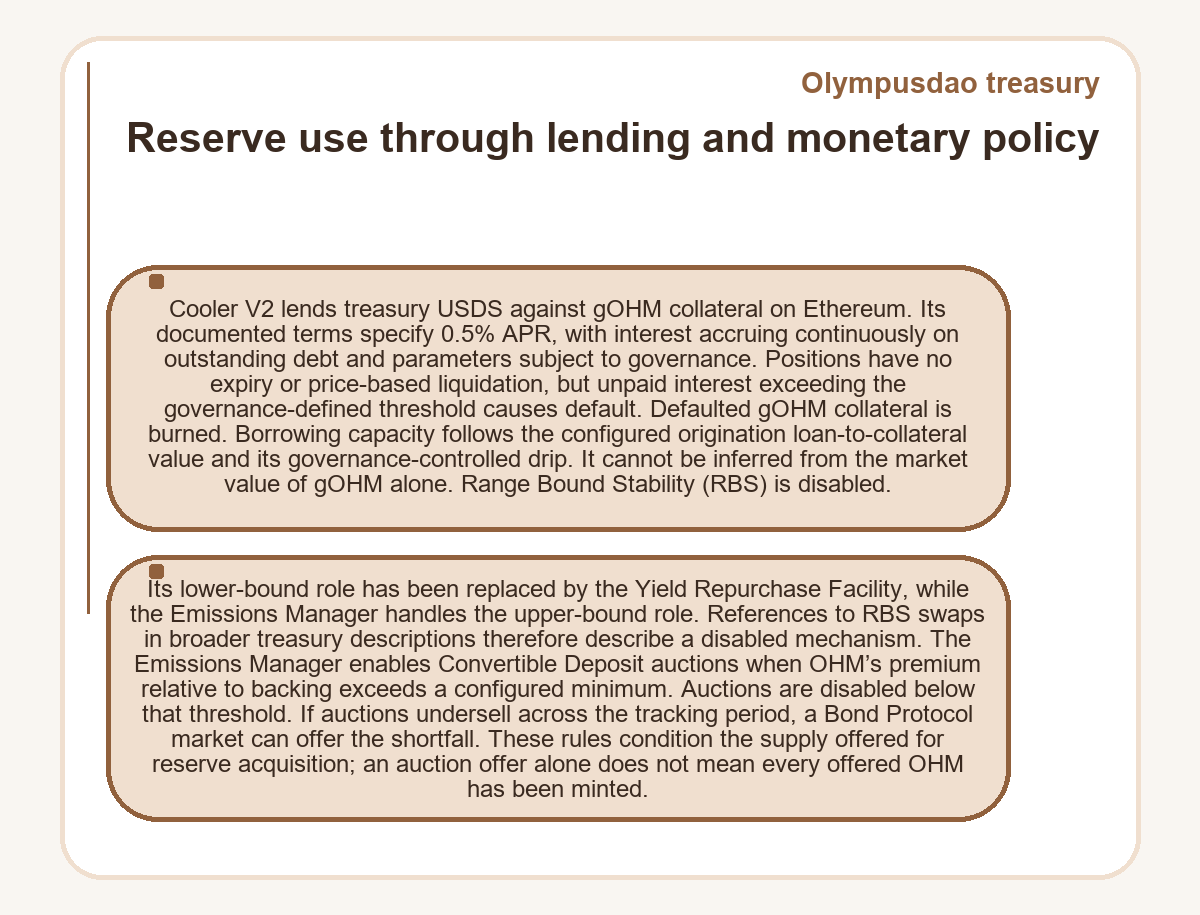
Borrowing capacity follows the configured origination loan-to-collateral value and its governance-controlled drip. It cannot be inferred from the market value of gOHM alone.
Range Bound Stability (RBS) is disabled. Its lower-bound role has been replaced by the Yield Repurchase Facility, while the Emissions Manager handles the upper-bound role. References to RBS swaps in broader treasury descriptions therefore describe a disabled mechanism.
The Emissions Manager enables Convertible Deposit auctions when OHM’s premium relative to backing exceeds a configured minimum. Auctions are disabled below that threshold. If auctions undersell across the tracking period, a Bond Protocol market can offer the shortfall. These rules condition the supply offered for reserve acquisition; an auction offer alone does not mean every offered OHM has been minted.
How treasury yield funds OHM repurchases
The Yield Repurchase Facility (YRF) uses realized yield from USDS savings reserves and Cooler Loans for OHM buybacks. It calculates funding weekly, draws sUSDS using a lagged earnings amount and distributes USDS into daily purchase markets.
Daily processing borrows USDS against the preceding day’s acquired OHM at a configured backing value, then burns that OHM. Recycling the backing funds further purchases, so gross buyback spending can exceed the initial yield budget.
Example: The same budget at two purchase prices
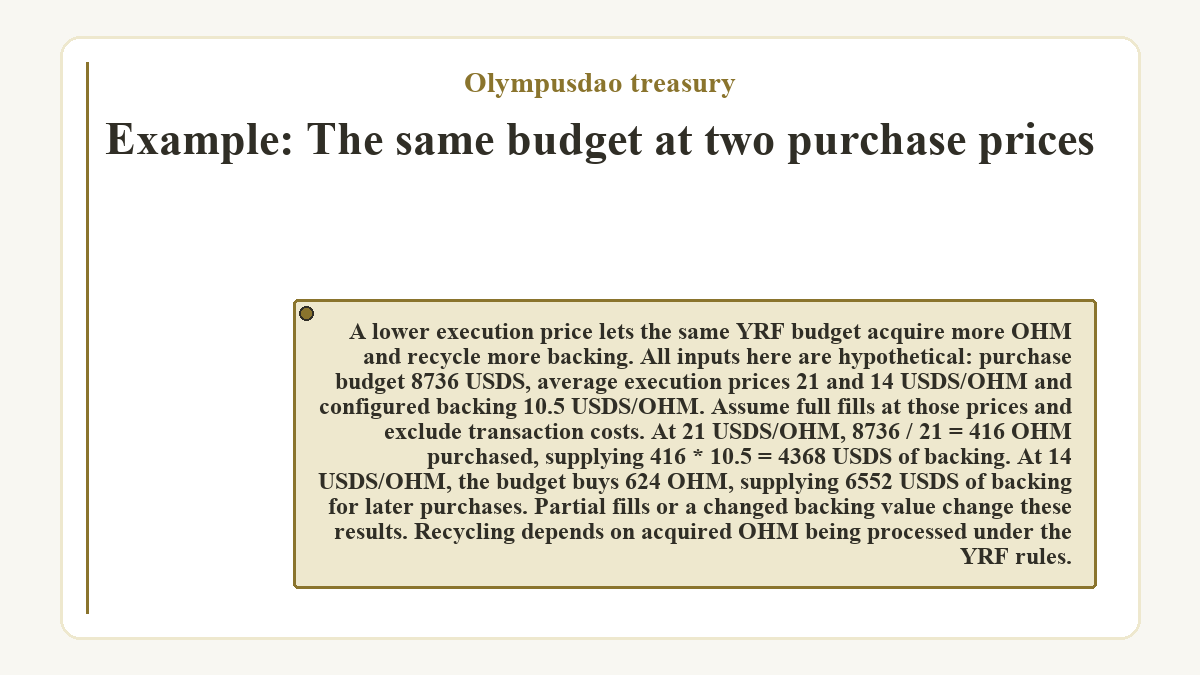
A lower execution price lets the same YRF budget acquire more OHM and recycle more backing.
All inputs here are hypothetical: purchase budget 8736 USDS, average execution prices 21 and 14 USDS/OHM and configured backing 10.5 USDS/OHM. Assume full fills at those prices and exclude transaction costs.
At 21 USDS/OHM, 8736 / 21 = 416 OHM purchased, supplying 416 * 10.5 = 4368 USDS of backing. At 14 USDS/OHM, the budget buys 624 OHM, supplying 6552 USDS of backing for later purchases.
Partial fills or a changed backing value change these results. Recycling depends on acquired OHM being processed under the YRF rules.
When user deposits become treasury capital
The DepositManager holds Convertible Deposit assets separately from treasury reserves. The assets can be held directly or in a configured ERC4626 vault. Access is restricted to the facility accepting the deposit; governance has no direct access to that user principal.
An eligible conversion before position expiry transfers the corresponding deposit assets to the treasury and mints OHM. Conversion requires the position record and matching receipt tokens; the receipt tokens are burned. Early reclaim contributes the withheld discount to the treasury.
Who can authorize asset use
Olympus governance can change policy parameters, activate or deactivate policies and authorize modules within the protocol’s role system. The documented treasury custodian role can approve or remove assets and is shared between the DAO multisig and Governor Bravo’s Timelock.